
Options Bot Risk Management: Essential Features
A trading bot is only as good as its risk controls. Learn about the essential features like dynamic stop-loss and portfolio allocation that protect your capital in automated options trading.
Beyond the Basics: Essential Risk Management Features for Your Options Trading Bot
In the world of options selling, the adage "manage your risk, and the profits will follow" is gospel. Options trading, particularly selling premium, involves high leverage and the potential for significant, rapid losses if not managed with ironclad discipline. For traders considering an automated approach, the primary concern is not profit generation, but options bot risk management.
A sophisticated trading bot is not just a tool for execution; it is your ultimate risk manager. It enforces rules without emotion, ensuring your capital is protected even in volatile market conditions.
Why is Risk Management More Critical in Automated Options Selling?
While automation removes human error in execution, it introduces the risk of a flawed strategy executing perfectly and repeatedly. Because options selling involves collecting premium for taking on risk, a single unmanaged trade can wipe out weeks or months of consistent gains. Therefore, the risk controls built into your algorithmic options trading platform are the most valuable features you possess.
What are the Essential Risk Management Features for an Options Bot?
1. Dynamic Stop-Loss and Take-Profit Orders
A simple stop-loss is a basic necessity, but a truly effective bot offers dynamic controls that adapt to the nature of options contracts.
•Percentage-Based Stop-Loss: The bot should allow you to set a stop loss for options selling bot based on a percentage of the premium received or the maximum potential loss. For example, automatically closing a short option if the loss reaches 100% of the premium collected (i.e., the trade is at break-even) or 200% (i.e., a defined loss). This is superior to a fixed price stop-loss, which doesn't account for the non-linear pricing of options.
•Time-Based Exit (Theta Management): Options decay accelerates in the final days before expiration (Gamma risk). A good bot can be programmed to automatically close a position after a certain number of days (e.g., 21 days to expiration) or when the position reaches a specific DTE threshold, effectively managing this risk.
•Take-Profit Automation: The bot should automatically close the position once a profit target (e.g., 50% of max profit) is reached. This is crucial for options selling, as holding for the last few dollars of premium exposes you to disproportionately higher risk. The bot locks in gains and frees up capital instantly.
2. Position Sizing and Portfolio Allocation
The biggest risk in trading is over-leveraging. A bot must enforce strict rules on how much capital is exposed at any given time, preventing the strategy from "blowing up" the account.
•Capital Allocation Limits: The bot should allow you to set a maximum percentage of your total portfolio capital that can be allocated to any single trade or strategy. For instance, you can program the bot to never use more than 5% of your account's buying power for a new trade, regardless of how attractive the premium is.
•Correlation Monitoring: Advanced bots can monitor the correlation between your open positions. If you have too many trades that are highly correlated (e.g., all tech stocks, or all trades based on the S&P 500), the bot can prevent new entries, forcing diversification and reducing portfolio-level risk. This protects you from a single market event causing catastrophic losses across your entire portfolio.
•Max Open Positions: A simple but effective control is limiting the total number of open positions. This ensures that you maintain a manageable level of complexity and risk exposure.
3. Real-Time Monitoring and Alerts
While the bot is designed to run autonomously, you need complete visibility into its actions and the market environment. This is the human-bot interface for risk management.
•Intuitive Dashboard: The platform must provide an intuitive dashboard that gives you a clear, real-time view of your bot's decisions, open positions, and current risk exposure. Key metrics like portfolio Delta, Theta, and Max Loss should be visible at a glance.
•Critical Alerts: The bot should be programmed to send immediate alerts (via email, SMS, or app notification) if a position is approaching a critical stop-loss level, if a margin call is imminent, or if a major market event occurs that requires human review.
•Manual Override Capability: In extreme, unforeseen market conditions (e.g., a "Black Swan" event), the platform must allow for a quick and easy manual override to pause the bot or close all positions instantly.
4. Strategy-Level Stress Testing
Before a bot ever places a live trade, its strategy must be proven resilient. This is where robust backtesting and stress-testing capabilities come into play.
•Simulated Market Crashes: The bot should allow you to simulate market crashes (like 2008 or March 2020) to see how your strategy and its risk controls would have performed. This is the ultimate validation of your options bot risk management plan.
•Sensitivity Analysis: Test how sensitive your strategy is to changes in key variables like Implied Volatility (IV) or interest rates. This helps you understand the strategy's weaknesses before they are exposed in a live market.
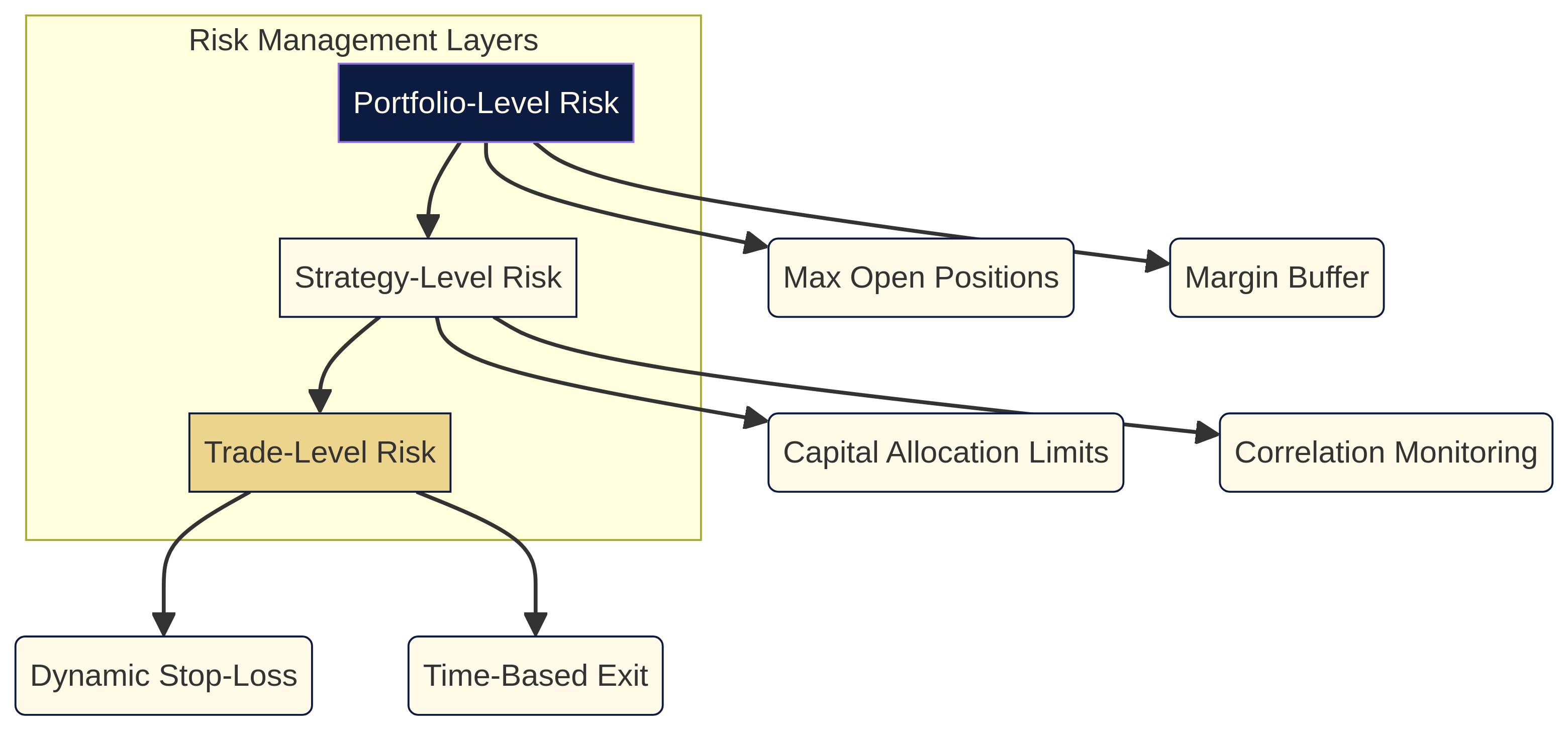
Visual Guide: Layered Risk Management Framework\n\n
\n\n## How to Implement a Robust Risk Management Framework with OptionBots
Implementing these features is a multi-step process that ensures a layered defense for your capital:
1.Define Portfolio-Level Risk: Set your maximum capital allocation and correlation limits first. This is the outer layer of defense.
2.Define Strategy-Level Risk: For each strategy, set the specific entry, exit, and stop-loss rules. This is the inner layer of defense.
3.Validate with Backtesting: Use the platform's backtesting engine to confirm that your risk settings would have protected your capital during historical periods of high volatility.
4.Deploy with Paper Trading: Run the bot in a paper trading environment for a few weeks to ensure the risk controls fire correctly and as expected before committing real capital.
Conclusion: Trade Smarter, Not Harder\n\n
A trading bot is a powerful tool, but its true value lies in its ability to manage risk with unwavering consistency. By choosing a platform that prioritizes these essential risk management features, you are not just automating your trades—you are installing a professional-grade risk desk that works for you 24/7.
See how OptionBots' advanced risk features protect your capital and enforce the discipline required for long-term success in options selling. Trading with a disciplined, automated risk framework is the key to sustainable profitability.